

Yo, folks! I'm a supplier of lab RO water machines, and I often get asked if these machines can be used for electrophoresis experiments. So, I thought I'd dive into this topic and share my thoughts.
First off, let's talk about what electrophoresis is. Electrophoresis is a technique used in labs to separate and analyze molecules like DNA, RNA, and proteins. It works by applying an electric field to a gel matrix, which causes the molecules to move based on their size and charge.
Now, the quality of water used in electrophoresis is super important. You need water that's really pure, with minimal impurities like ions, particles, and organic compounds. That's where lab RO water machines come in.
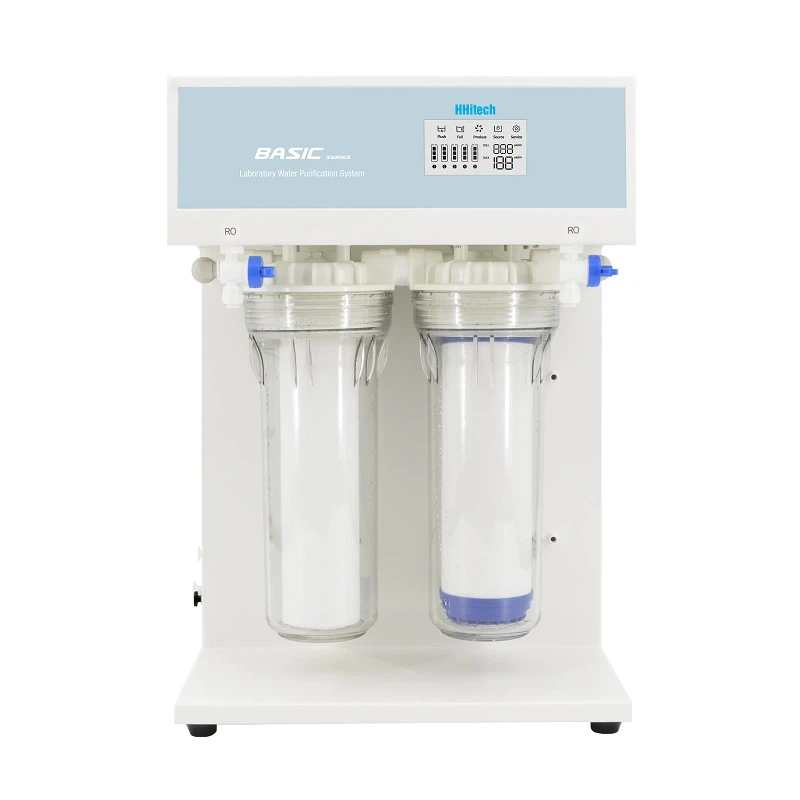

RO stands for reverse osmosis. A lab RO water machine uses a semi - permeable membrane to remove a large number of contaminants from the water. It works by forcing water through the membrane under pressure, leaving behind most of the impurities.
So, can a lab RO water machine be used for electrophoresis experiments? The short answer is yes, but there are some things to consider.
Purity Level
For electrophoresis, you want water with a very low conductivity. Conductivity is a measure of how well water can conduct an electric current, and high conductivity can mess up your electrophoresis results. Most lab RO water machines can produce water with a relatively low conductivity, but it might not be pure enough on its own.
Some electrophoresis applications, especially those involving high - precision analysis, might require even purer water. In these cases, you might need to use additional purification steps after the RO process, like deionization or distillation.
Particle and Organic Matter
Apart from ions, you also need to worry about particles and organic matter in the water. These can interfere with the separation of molecules in the gel. A good lab RO water machine can remove a significant amount of particles and organic compounds. However, if your RO system is old or not well - maintained, it might not do as good a job.
Our RO Water Systems
We offer a range of RO water systems that can be a great fit for electrophoresis experiments.
The Basic - RO Series Reverse Osmosis Water System is a great entry - level option. It's designed to provide a reliable supply of relatively pure water. It's easy to operate and maintain, making it a good choice for smaller labs or those on a budget.
The Medium - RO Series Reverse Osmosis Water System takes things a step further. It offers higher purification efficiency and can produce water with a lower conductivity compared to the basic series. This system is suitable for a wider range of electrophoresis applications.
If you need even more advanced purification, our Medium - 1600RO Series Reverse Osmosis Water System is the way to go. It's designed for high - volume and high - precision applications. With advanced filtration technology, it can remove even the smallest impurities, ensuring that your electrophoresis experiments are as accurate as possible.
Maintenance
To ensure that your lab RO water machine continues to produce high - quality water for your electrophoresis experiments, regular maintenance is crucial. You need to change the filters and membranes at the recommended intervals. This helps to keep the purification process efficient and ensures that the water quality remains consistent.
Cost - Benefit Analysis
Using a lab RO water machine for electrophoresis can be cost - effective in the long run. Buying pre - purified water can be expensive, especially if you're running a lot of experiments. With your own RO water machine, you can produce your own water on - demand, saving money over time.
However, you need to factor in the initial cost of the machine and the cost of maintenance. But if you do the math, you'll find that in most cases, it's a smart investment.
Conclusion
In conclusion, a lab RO water machine can definitely be used for electrophoresis experiments. While it might not always produce water that's pure enough for every single application without additional purification steps, it's a great starting point.
If you're in the market for a lab RO water machine for your electrophoresis needs, we're here to help. Our range of RO water systems, including the Basic - RO Series Reverse Osmosis Water System, Medium - RO Series Reverse Osmosis Water System, and Medium - 1600RO Series Reverse Osmosis Water System, are designed to meet different requirements and budgets.
If you have any questions or want to discuss your specific needs, don't hesitate to reach out. We're happy to help you choose the right RO water system for your electrophoresis experiments and guide you through the procurement process.
References
- Principles of Electrophoresis, BioTechniques Journal
- Reverse Osmosis Water Purification: A Practical Guide, Water Treatment Association


