

As a leading supplier of Type III water systems, I'm often asked about how these systems purify water. In this blog post, I'll take you through the process, explaining the key stages and technologies involved in producing high - quality Type III water.
Understanding Type III Water
Before delving into the purification process, it's important to understand what Type III water is. Type III water, also known as RO water (Reverse Osmosis water), is a grade of purified water commonly used in laboratories for general applications such as glassware rinsing, autoclave feed, and some non - critical analytical procedures. It has a relatively low level of impurities compared to tap water, but not as high a purity as Type I or Type II water.
The Purification Process of a Type III Water System
1. Pre - treatment
The first step in the purification process is pre - treatment. Tap water, which is usually the source water for Type III water systems, contains various contaminants such as sediment, chlorine, and large organic molecules. These contaminants can damage the reverse osmosis membranes used later in the process, so they need to be removed.
- Sediment Filtration: A sediment filter is the first line of defense. It removes large particles like sand, dirt, and rust from the water. This filter typically has a pore size ranging from 1 to 5 microns, depending on the quality of the source water. By removing these large particles, the sediment filter protects the subsequent components of the water system from clogging.
- Activated Carbon Filtration: After sediment filtration, the water passes through an activated carbon filter. Activated carbon has a large surface area with many pores, which can adsorb chlorine, organic compounds, and some heavy metals. Chlorine is a common disinfectant in tap water, but it can oxidize and damage reverse osmosis membranes. The activated carbon filter effectively removes chlorine, ensuring the longevity of the membranes.
2. Reverse Osmosis (RO)
Reverse osmosis is the heart of the Type III water purification process. It is a technology that uses a semi - permeable membrane to separate water molecules from dissolved salts, ions, and other contaminants.
- How Reverse Osmosis Works: In a reverse osmosis system, water is forced through a semi - permeable membrane under pressure. The membrane has extremely small pores that allow only water molecules to pass through, while rejecting most dissolved solids, including salts, bacteria, and viruses. The pressure required for reverse osmosis is typically higher than the natural osmotic pressure, hence the term "reverse" osmosis.
- Our Reverse Osmosis Systems: We offer a range of reverse osmosis water systems, including the Basic - RO Series Reverse Osmosis Water System, the Smart - RO Series Reverse Osmosis Water System, and the Medium - 1600RO Series Reverse Osmosis Water System. These systems are designed to provide efficient and reliable reverse osmosis purification, with different flow rates and features to meet various user requirements.
3. Post - treatment
After reverse osmosis, the water may still contain a small amount of residual contaminants. Post - treatment processes are used to further improve the water quality.
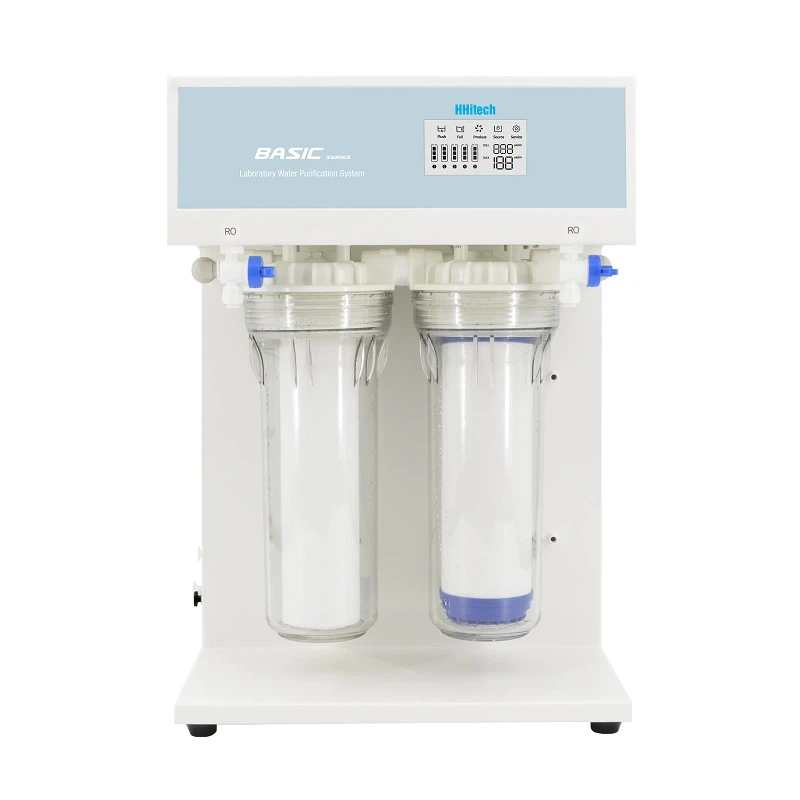

- Deionization (DI): Deionization is a process that removes ions from the water using ion - exchange resins. These resins are made up of small beads that have a specific charge. Cation exchange resins remove positively charged ions (such as calcium, magnesium, and sodium), while anion exchange resins remove negatively charged ions (such as chloride, sulfate, and carbonate). By passing the water through a mixed - bed ion - exchange resin column, most of the remaining ions can be removed, resulting in a lower conductivity and higher purity of the water.
- UV Sterilization: Ultraviolet (UV) sterilization is another common post - treatment method. UV light has a germicidal effect, which can inactivate bacteria, viruses, and other microorganisms in the water. The UV light damages the DNA of these microorganisms, preventing them from reproducing and rendering them harmless. This process is especially important for applications where microbiological purity is required.
Monitoring and Control
Throughout the purification process, it is essential to monitor and control the water quality. Our Type III water systems are equipped with various sensors and monitoring devices to ensure that the water meets the required standards.
- Conductivity Sensors: Conductivity is a measure of the ability of water to conduct an electric current, which is related to the concentration of dissolved ions in the water. Conductivity sensors are used to continuously monitor the ion content of the water. If the conductivity exceeds a pre - set limit, it indicates that there may be a problem with the purification process, such as a membrane failure or resin exhaustion.
- Flow Meters: Flow meters are used to measure the flow rate of the water through the system. This information is important for ensuring that the system is operating at the designed capacity and for detecting any blockages or leaks in the pipes.
Benefits of Our Type III Water Systems
- High - Quality Water: Our Type III water systems are designed to produce high - quality water that meets the relevant standards for laboratory applications. The combination of pre - treatment, reverse osmosis, and post - treatment processes ensures that the water is free from most contaminants, providing reliable results for your experiments and procedures.
- Reliability and Durability: We use high - quality components and advanced manufacturing techniques in our water systems. The sediment filters, activated carbon filters, reverse osmosis membranes, and ion - exchange resins are all carefully selected to ensure long - term performance and durability.
- Customizability: We understand that different users have different requirements. That's why we offer a range of water systems with different flow rates, features, and configurations. Whether you need a small - scale system for a single laboratory or a large - scale system for a research institution, we can provide a customized solution to meet your needs.
Contact Us for Purchase and Negotiation
If you are interested in our Type III water systems and would like to learn more about the products, pricing, or technical details, we invite you to contact us. Our sales team is ready to assist you with your inquiries and to discuss the best solution for your specific requirements. We look forward to establishing a long - term partnership with you and providing you with high - quality water purification products and services.
References
- ASTM D1193 - 19 Standard Specification for Reagent Water.
- American Water Works Association (AWWA) Manual M46: Laboratory Water Quality.
- Water Quality Association (WQA) Standards and Testing Procedures.


