

As a supplier of lab RO water machines, I've witnessed firsthand the critical role that water quality plays in laboratory settings. The output water quality from a lab RO water machine can significantly impact the accuracy and reliability of experimental results. In this blog, I'll delve into the various factors that can affect the water quality of the output water from a lab RO water machine.
1. Feed Water Quality
The quality of the feed water is the primary factor influencing the output water quality of a lab RO water machine. Feed water can contain a variety of contaminants, including suspended solids, dissolved salts, organic matter, and microorganisms.
Suspended solids, such as sand, silt, and clay, can clog the RO membrane, reducing its efficiency and lifespan. To prevent this, pre - filtration systems are commonly used to remove these particles. For example, a sediment filter with a pore size of 5 - 20 microns can effectively trap larger suspended solids before they reach the RO membrane.

Dissolved salts, including sodium, calcium, magnesium, and chloride ions, are a major concern in RO systems. The RO membrane works by rejecting these salts through a process of reverse osmosis. However, the rejection rate can be affected by the type and concentration of salts in the feed water. High levels of certain salts, such as sulfate and silica, can cause scaling on the membrane surface, which can reduce the membrane's performance and lead to higher maintenance costs.
Organic matter, such as humic and fulvic acids, can foul the RO membrane. These substances can adsorb onto the membrane surface, creating a layer that inhibits the passage of water and increases the pressure required to operate the system. Additionally, organic matter can serve as a food source for microorganisms, leading to biofouling.
Microorganisms, including bacteria, viruses, and fungi, can contaminate the feed water and grow on the RO membrane. Biofouling can not only reduce the membrane's performance but also pose a risk to the quality of the output water. To control microbial growth, pre - treatment steps such as chlorination or the use of ultraviolet (UV) disinfection can be employed.
2. RO Membrane Characteristics
The characteristics of the RO membrane itself play a crucial role in determining the output water quality. The membrane's material, pore size, and surface properties can all affect its rejection rate and fouling resistance.
Most RO membranes are made of thin - film composite (TFC) materials, which consist of a polyamide active layer supported by a porous substrate. The polyamide layer is responsible for the rejection of contaminants, while the substrate provides mechanical support. The quality of the polyamide layer can vary depending on the manufacturing process, and higher - quality membranes generally offer better rejection rates and longer lifespans.
The pore size of the RO membrane is another important factor. RO membranes have very small pores, typically on the order of 0.0001 - 0.001 microns, which allows them to reject most dissolved salts and contaminants. However, the pore size can also affect the water flux, or the rate at which water passes through the membrane. A membrane with a smaller pore size may have a higher rejection rate but a lower water flux.
The surface properties of the RO membrane can influence its fouling resistance. Membranes with a smooth surface are less likely to adsorb contaminants and are therefore more resistant to fouling. Some membranes are also treated with anti - fouling agents to further improve their performance.
3. Operating Conditions
The operating conditions of the lab RO water machine can have a significant impact on the output water quality. These conditions include pressure, temperature, flow rate, and recovery rate.
Pressure is one of the most important operating parameters. The RO process requires a certain amount of pressure to force water through the membrane against the osmotic pressure. Insufficient pressure can result in low water production and poor rejection of contaminants, while excessive pressure can damage the membrane. The optimal operating pressure depends on the type of membrane and the feed water quality.
Temperature can also affect the performance of the RO membrane. Generally, as the temperature increases, the water flux through the membrane also increases. However, high temperatures can also reduce the membrane's rejection rate and increase the risk of membrane degradation. Most RO membranes are designed to operate within a specific temperature range, typically between 5°C and 45°C.
The flow rate of the feed water and the permeate (output water) is another critical factor. A proper flow rate is necessary to ensure that the membrane is adequately rinsed and that contaminants are not allowed to accumulate on the membrane surface. If the flow rate is too low, the membrane may become fouled, while a flow rate that is too high can cause excessive pressure drop and reduce the efficiency of the system.
The recovery rate, which is the ratio of the permeate flow rate to the feed water flow rate, can also impact the output water quality. A higher recovery rate means that more water is being recovered from the feed water, but it also increases the concentration of contaminants in the concentrate (the water that is rejected by the membrane). If the recovery rate is too high, the increased concentration of contaminants can lead to scaling and fouling of the membrane.
4. System Design and Maintenance
The design of the lab RO water machine and the frequency of maintenance can also affect the output water quality.
A well - designed RO system should include appropriate pre - treatment and post - treatment components. As mentioned earlier, pre - treatment is essential for removing suspended solids, organic matter, and microorganisms from the feed water. Post - treatment steps, such as deionization or polishing, can be used to further improve the water quality by removing any remaining contaminants.
Regular maintenance is crucial for ensuring the optimal performance of the RO system. This includes replacing pre - filters, sanitizing the system, and monitoring the membrane's performance. Over time, the RO membrane will naturally degrade and its performance will decline. Regular membrane replacement is necessary to maintain the desired output water quality.
5. Our Lab RO Water Machines
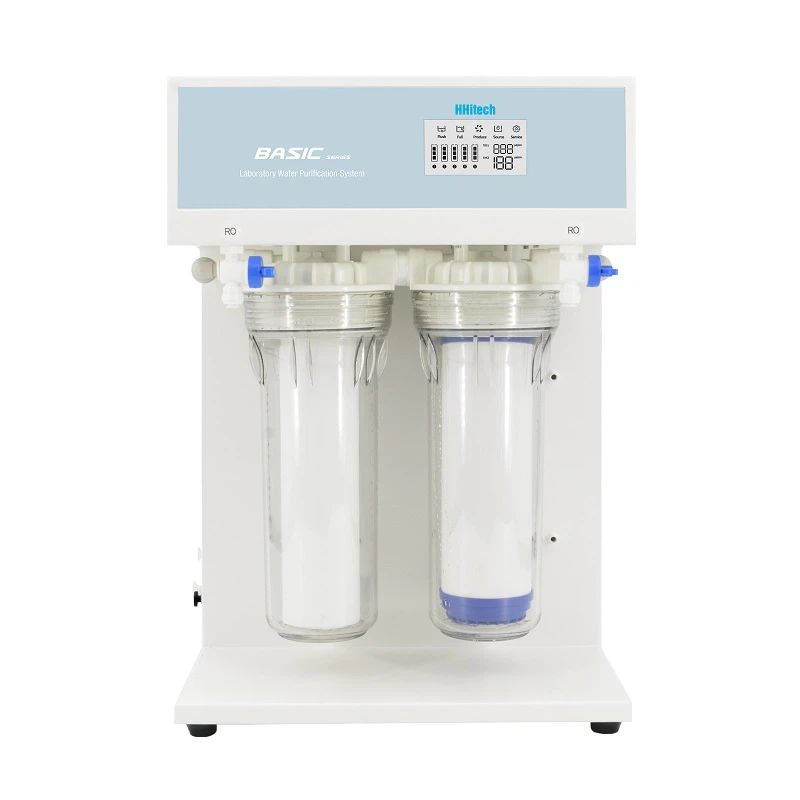
At our company, we offer a range of high - quality lab RO water machines, including the Medium - RO Series Reverse Osmosis Water System, Basic - RO Series Reverse Osmosis Water System, and Medium - 1600RO Series Reverse Osmosis Water System. These systems are designed to provide reliable and consistent output water quality, even in challenging laboratory environments.
Our RO water machines are equipped with advanced pre - treatment and post - treatment components to ensure the removal of a wide range of contaminants. The membranes used in our systems are of the highest quality, offering excellent rejection rates and fouling resistance. Additionally, our systems are designed with user - friendly features, such as easy - to - replace filters and intuitive control panels, to simplify maintenance and operation.
Contact Us for Procurement
If you're in the market for a lab RO water machine and want to ensure the highest quality output water, we'd love to hear from you. Our team of experts can help you select the right system for your specific needs and provide you with comprehensive support and maintenance services. Don't hesitate to reach out to us to start a procurement discussion.
References
- Cheryan, M. Ultrafiltration and Microfiltration Handbook. Technomic Publishing, 1998.
- Belfort, G., Davis, R. H., & Zydney, A. L. "The behavior of suspensions and macromolecular solutions in crossflow microfiltration." Journal of Membrane Science, 1994, 96(1 - 2), 1 - 58.
- Porter, M. C. Handbook of Industrial Membrane Technology. Noyes Publications, 1990.


