

As a supplier of lab RO water machines, I've had numerous inquiries about the operating principle of the reverse osmosis (RO) membrane in these machines. Understanding this principle is crucial not only for those in the scientific community who rely on high - purity water for their experiments but also for anyone interested in water purification technology. In this blog, I'll delve into the science behind the RO membrane in a lab RO water machine.
The Basics of Osmosis and Reverse Osmosis
To understand reverse osmosis, we first need to grasp the concept of osmosis. Osmosis is a natural process where solvent molecules (usually water) move through a semi - permeable membrane from an area of lower solute concentration to an area of higher solute concentration. This movement continues until the solute concentration on both sides of the membrane reaches equilibrium.
Reverse osmosis, on the other hand, is an artificial process that reverses the natural flow of osmosis. In a lab RO water machine, pressure is applied to the side of the membrane with a higher solute concentration. This pressure overcomes the osmotic pressure, forcing the water molecules to move from the high - solute side to the low - solute side through the semi - permeable membrane, leaving behind most of the dissolved salts, organic compounds, and other contaminants.
Structure of the RO Membrane
The RO membrane is the heart of a lab RO water machine. It is typically made of a thin - film composite (TFC) material. The TFC membrane consists of three layers: a polyester support layer, a polysulfone microporous layer, and a polyamide active layer.
The polyester support layer provides mechanical strength to the membrane. It is a relatively thick and porous layer that can withstand the high pressures applied during the reverse osmosis process. The polysulfone microporous layer acts as an intermediate layer, providing a smooth surface for the deposition of the polyamide active layer.
The polyamide active layer is the key to the membrane's separation performance. It is extremely thin, usually only a few hundred nanometers thick. This layer has a dense structure with tiny pores that are small enough to allow water molecules to pass through while blocking most dissolved salts, bacteria, viruses, and other contaminants. The size of the pores in the polyamide layer is typically on the order of 0.1 to 1 nanometer.
The Reverse Osmosis Process in a Lab RO Water Machine
In a lab RO water machine, the reverse osmosis process can be divided into several steps:
Pre - treatment
Before the water enters the RO membrane, it undergoes pre - treatment to remove large particles, sediment, and chlorine. Large particles and sediment can clog the RO membrane, reducing its efficiency and lifespan. Chlorine can damage the polyamide active layer of the RO membrane, so it must be removed. Pre - treatment typically includes sediment filters and activated carbon filters.
Pressurization
After pre - treatment, the water is pumped into the RO membrane module at high pressure. The pressure required for reverse osmosis depends on the feed water quality and the type of RO membrane. In general, pressures between 150 and 400 psi (pounds per square inch) are commonly used in lab RO water machines.

Separation
As the pressurized water flows through the RO membrane, water molecules pass through the membrane pores, while most of the dissolved salts, organic compounds, and other contaminants are retained on the feed side of the membrane. The water that passes through the membrane is called the permeate, which is the purified water output of the RO system. The water that contains the retained contaminants is called the concentrate or reject water, which is typically discharged from the system.
Post - treatment
The permeate water may still contain a small amount of residual contaminants or have a slightly acidic pH. Post - treatment steps are often used to further improve the water quality. These steps may include deionization using ion - exchange resins to remove any remaining ions, ultraviolet (UV) sterilization to kill any remaining bacteria or viruses, and polishing using a final filter to remove any remaining particulate matter.
Factors Affecting RO Membrane Performance
Several factors can affect the performance of the RO membrane in a lab RO water machine:
Feed Water Quality
The quality of the feed water has a significant impact on the membrane's performance. High levels of dissolved salts, organic matter, or suspended solids can increase the fouling and scaling of the membrane, reducing its efficiency and lifespan. For example, if the feed water contains a high concentration of calcium carbonate, it may form scale on the membrane surface, blocking the pores and reducing the water flux.
Pressure
The pressure applied during the reverse osmosis process is crucial. Insufficient pressure may result in low water flux and poor rejection of contaminants. On the other hand, excessive pressure can damage the membrane, leading to membrane compaction or even rupture.
Temperature
The temperature of the feed water also affects the membrane performance. As the temperature increases, the viscosity of water decreases, which increases the water flux through the membrane. However, high temperatures can also accelerate the degradation of the membrane material, reducing its lifespan.
Flow Rate
The flow rate of the feed water and the concentrate water affects the membrane's performance. A proper flow rate is required to ensure that the membrane is continuously flushed with water, preventing the accumulation of contaminants on the membrane surface.
Our Lab RO Water Machine Offerings
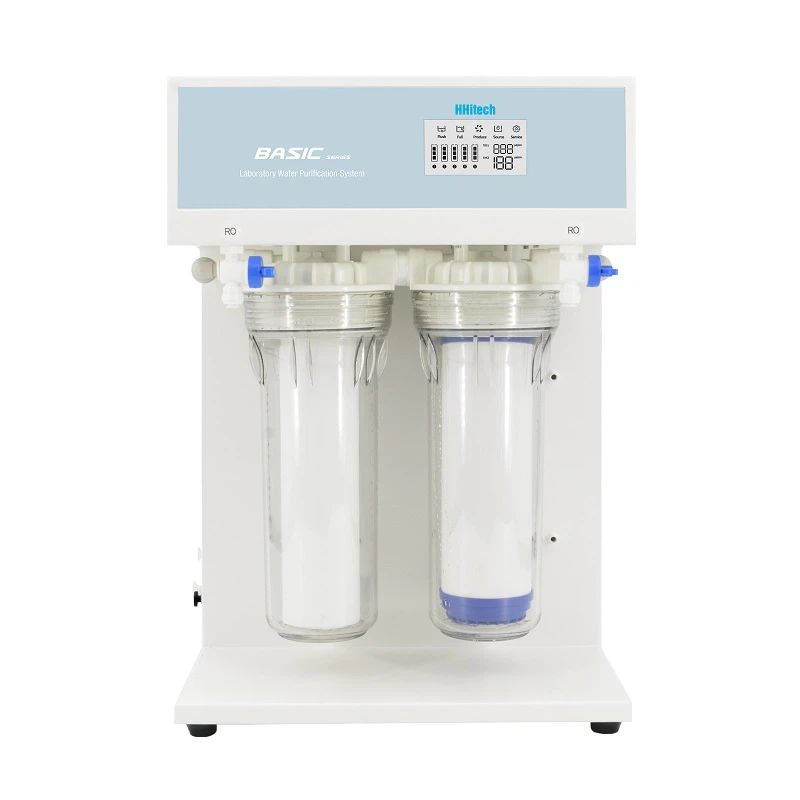
At our company, we offer a range of lab RO water machines to meet different customer needs. Our Basic - RO Series Reverse Osmosis Water System is a cost - effective solution for basic laboratory applications. It provides reliable water purification with a simple and easy - to - operate design.
For more demanding applications, our Medium - RRO Series Reverse Osmosis Water System offers higher water production capacity and better purification performance. It is suitable for medium - sized laboratories that require a large amount of high - purity water.
Our Smart - RO Series Reverse Osmosis Water System is the most advanced option. It features intelligent control systems, real - time monitoring of water quality, and remote access capabilities, providing users with a convenient and efficient water purification solution.
Conclusion
The reverse osmosis membrane in a lab RO water machine is a remarkable piece of technology that can effectively remove a wide range of contaminants from water, providing high - purity water for laboratory applications. By understanding the operating principle, structure, and factors affecting the performance of the RO membrane, users can better operate and maintain their lab RO water machines.
If you are interested in our lab RO water machines or have any questions about reverse osmosis technology, please feel free to contact us for more information and to discuss your specific requirements. We are committed to providing you with the best water purification solutions for your laboratory.
References
- Cheryan, M. Ultrafiltration and Microfiltration Handbook. Technomic Publishing, 1998.
- Mulder, M. Basic Principles of Membrane Technology. Kluwer Academic Publishers, 1996.
- Sourirajan, S. Reverse Osmosis. Academic Press, 1970.


